Mount Cruiser
June 25, 2023
1860m
Olympic National Park, WA
Mt. Cruiser, the highest tower on Sawtooth Ridge, is an iconic objective in the southern Olympics that does not have an “easy” way to the top. The first time I saw this peak was from Mt. Ellinor in 2017 but I needed to team up with a rock climber as I wasn’t sure if I was keen to lead that exposed and sparsely protected 5th class pitch. The approach is long and arduous. The climb to Needle Pass often involves 40+ degrees snow making mountaineering boots, ice axe and crampons essential in the early season. This should not be the reason to choose late summer as the trade-off is hardpacked choss on dirt. To summarize, a car-to-car ascent of Mt. Cruiser requires 30 km of hiking, 40-45 degrees snow, low 5th class climbing (a 60 m rope is required to rappel) and a heavy ass pack to load the associated gears. Most parties ended up taking over 15 hours. I eventually convinced Elise to join after taking her up Mt. Pershing so that she could see the striking profile of Mt. Cruiser. Kostya had never used a rope before, but had been demonstrating his fitness and incredible scrambling/free soloing ability, so a team was formed. Kostya offered to drive his Tesla to save gas, and we decided to drive around to Olympia instead of waiting at the ferry.
The three of us grouped in White Rock at 5 pm on Saturday and made quick work crossing the border. The border traffic was surprisingly low on a summer Saturday. Kostya was able to pass all the vehicles on I-5 except for the cop cars but we needed to stop two times to charge up the Tesla. We also made one stop for dinner and the restaurant was absurdly slow, so we didn’t get to the trail-head until 11:30 pm. There’s one stretch of gravel road on the north shore of Lake Cushman, but the road became paved again once entering the national park. Due to the afternoon thunderstorms we decided to start hiking at 3 am, so we simply pitched the tents beside our vehicle on the pavement in the parking lot. I’ve done this many times in Canada and U.S. and never got caught, as there wouldn’t be any ranger coming at midnight to kick us out. The alarms went off at 2:20 am but we were a little bit slower than anticipated. I did also need to cook (ramen with SPAM) so that added some time.

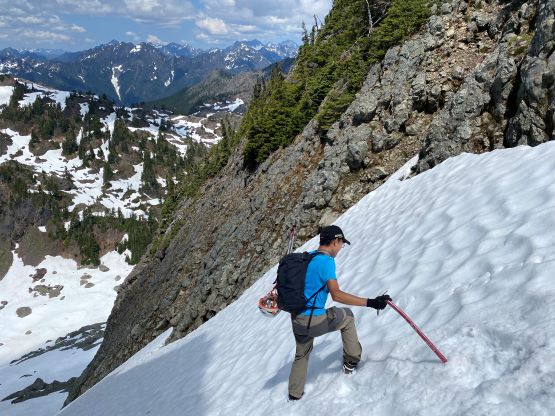
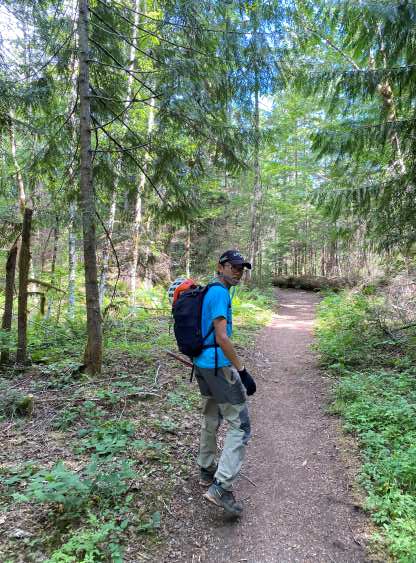
In any case we started the long ass plod in the pitch dark. There are two ways to start this hike and we opted to take the south side “Staircase Loop” both ways as per the GPX track that we downloaded. In about 2 km the trail led us crossing North Fork Skokomish River to the north side and several more boring kilometers later we reached the turn-off to Flapjack Lake. This narrower trail had a few annoying blowdowns so some trail work is needed. We finally started to gain elevation rapidly after the trail made a turn due east, and not long after we made to Flapjack Lake. The head-lamps were no longer required but the surroundings were still dark due to the west-facing orientation. Not doing any stopping we resumed the plod towards Gladys Divide. The quality of this uppermost trail was not bad. At 1400 m we started to encounter snow and it’s also here that we found a stream of running water to load up the water bottles. We took the first break of the day here, and the second break a mere 15 minutes later in the basin immediately under the slope below Needle Pass. There’s a patch of dry rocks for us to change footwear and don crampons. Elise and I had carried our mountaineering boots all the way here and the slope did appear steep enough to warrant the use of them. We also left some gears behind but hided them in the bushes as I’ve read a trip report in which their poles got stolen in this area.


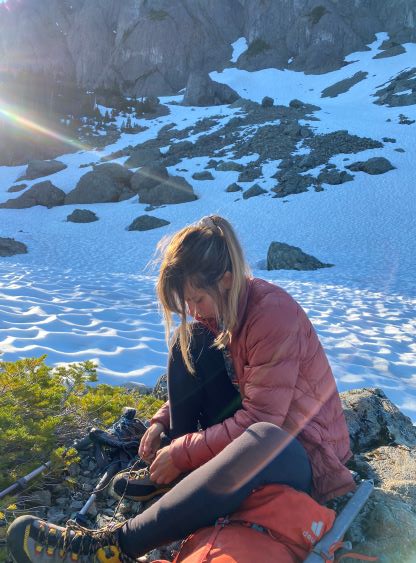
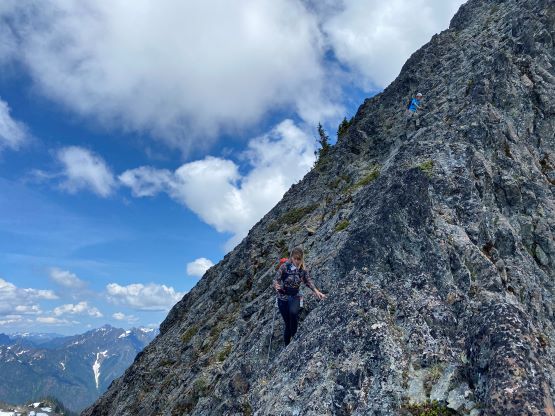
Elise opted for a head-start while I stayed behind to make sure Kostya could don his crampons properly. This was his 3rd time using crampons (first time on Cotopaxi, and second time on Mt. Pershing). I then took off and caught up to Elise at Needle Pass. We could only kick the front 1/3 of the boots into the slope and the angle was 40-45 degrees. Kostya did not own mountaineering boots and the hiking shoes were not sufficient for the job in the early morning hours. Kostya eventually scrambled the awkward and wet down-sloping rocks on climber’s left, which took a while. Meanwhile Elise somehow sensed that “The Needle” could be scrambled and immediately started free soloing. I went only a short ways up as the terrain beyond was clearly 5th class. Elise eventually got to about halfway up and then down-climbed. I went away and saw a rappel anchor on the very summit of that spire, but I wasn’t sure if those guys rappelled in one or two 60 m ropes. It was not obvious if a 30-m rappel would be sufficient enough. There wasn’t any obvious spot to build an intermediate anchor so we didn’t climb The Needle, but otherwise we would like to. Meanwhile Kostya finished his rock route. We all ditched our crampons, ice axes and gloves at Needle Pass and proceeded onwards scrambling up “Beta”. This was a mistake as we encountered more snow slopes later. The scrambling on “Beta” was trickier than expected with consistent route-finding, but did not exceed the realm of “3rd class”.
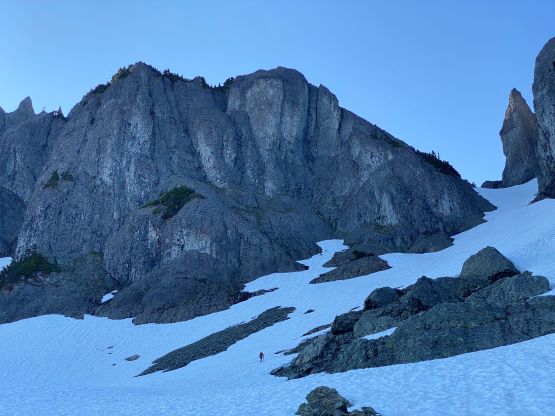

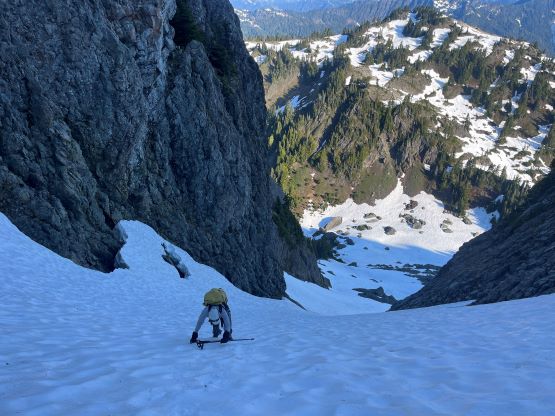


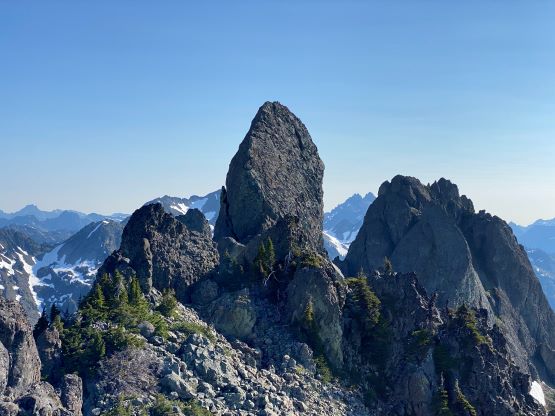

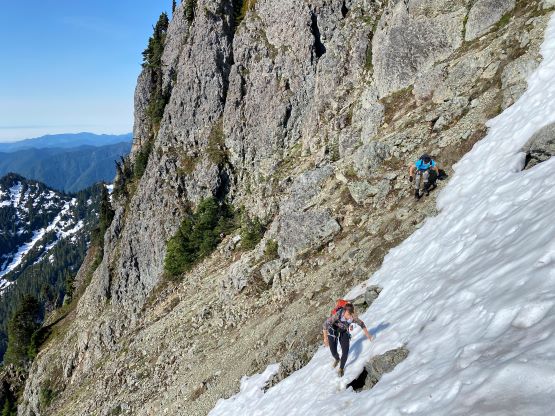
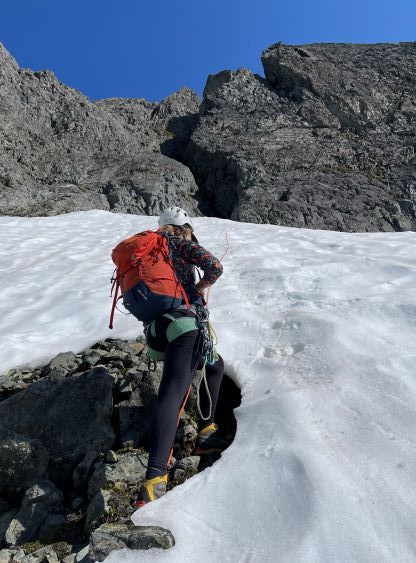
The traverse across the top of “Beta” was awkward and involved two descents off two gullies. The first gully was immediately after the summit. Other than one 4th class long reach it was straightforward. There’s some re-ascending on boulders to access the second gully, which was longer and chossier. It was a bit frustrating as we needed to regain all of the lost elevation on the way back. While descending this 3rd class second gully we realized the snow slope under the infamous cannon hole gully could not be avoided. The worst case scenario I would go back to get our crampons which would cost at most 1 hour delay, so we proceeded downwards to check out some possibilities. The decision was then made to skirt around the snow slope on skier’s right until we were directly beneath the gully. I then trailed the rope up, kicking 2-3 times per step while using my fingers to hold myself onto the 40-degree snow. It did not feel very secure but I got to the moat without incident and belayed Elise and Kostya up. The snow to rock transition wasn’t difficult and the 4th class cannon hole gully didn’t appear dauntingly difficult neither, so we coiled the rope and soloed up. I did make everyone to don rock shoes and we together ditched two backpacks to make the scrambling more efficient. The gully was tougher than I thought and I’m sure a lot of people would want to have a belay, especially in the lower half.
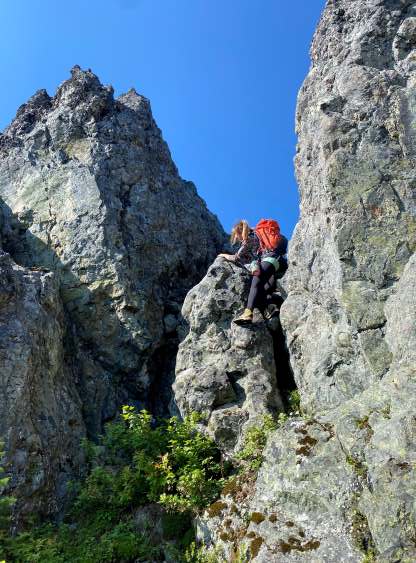
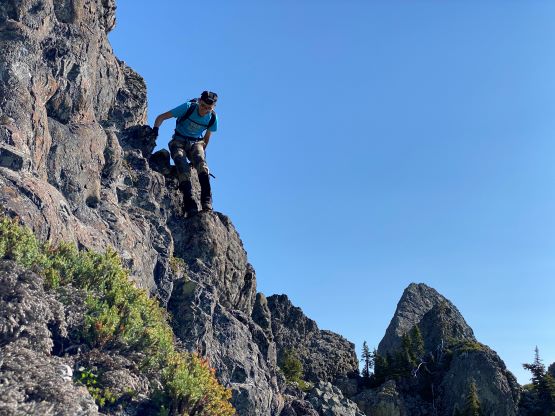
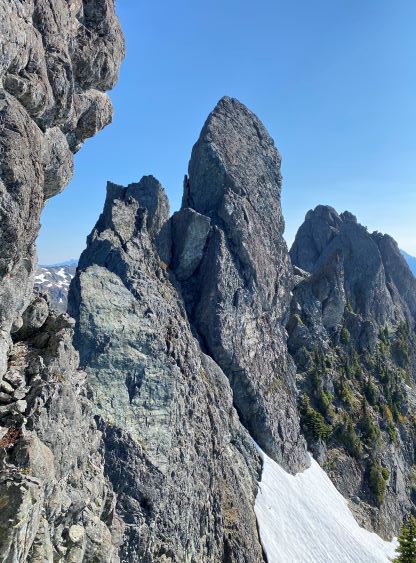
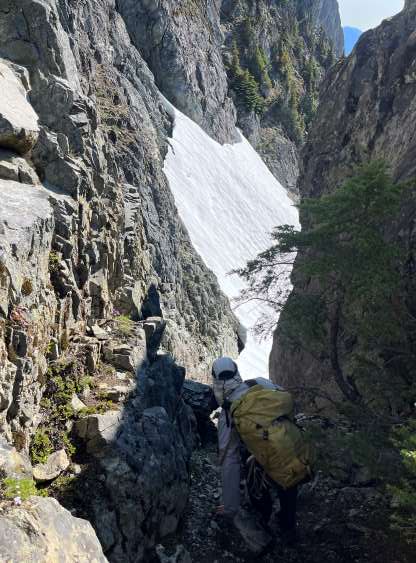



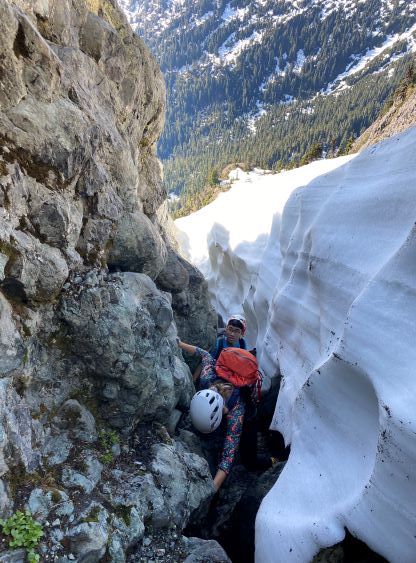

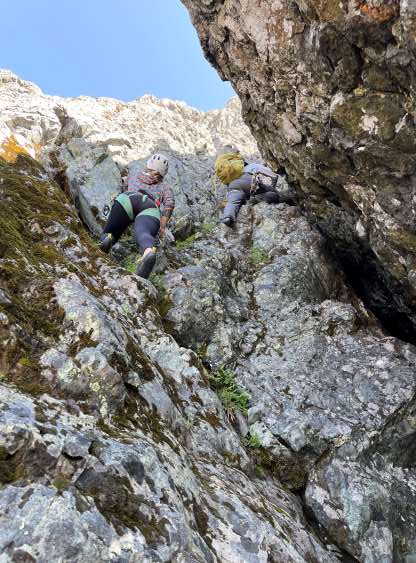
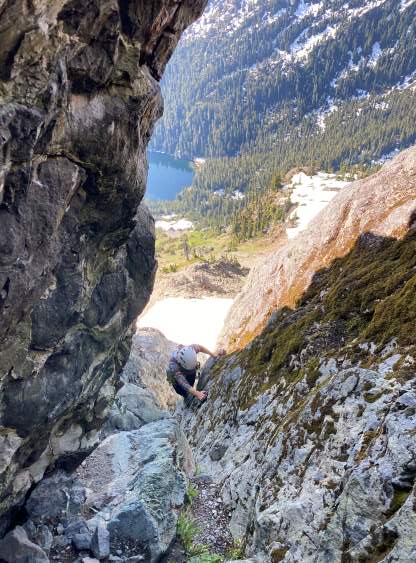
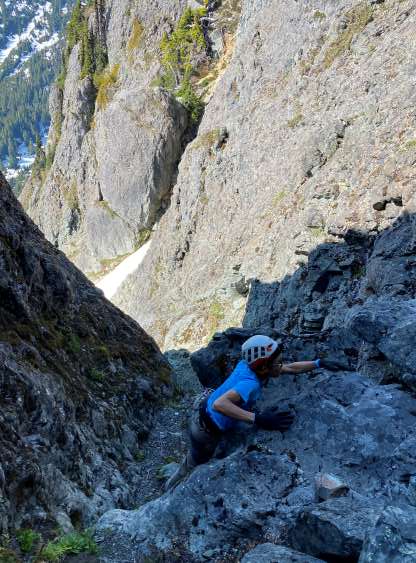
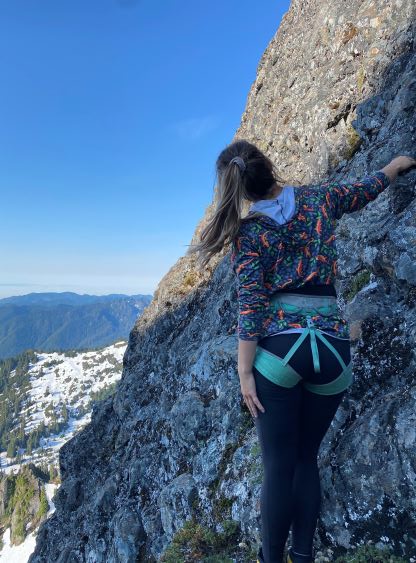
I had read Adam Walker’s trip report so we had two options to exit the gully. The tradition way was to scramble through the cannon hole on the left side, but Adam’s party climbed a low 5th class wall on the right side and reported that to be “more fun”. After seeing that wall we immediately decided to climb that, and I didn’t bother to even check out the cannon hole. We ditched our 3rd backpack at the base of this short pitch and immediately started free soloing. I backed off after encountering a few vertical moves on down-sloping foot holds, but Kostya took over and easily soloed up. Meanwhile Elise trailed the rope up taking a different line. I could have asked for a belay, but opted to give Kostya’s a line a second try and this time I sent it without a problem. A short transition across the wide ledge later we arrived at the base of the proper climbing pitch. Elise gingerly led out from the middle of our 60-m rope, placing one nut, two cams and a clip to a rusted bolt in the middle of the pitch. Elise did not make this pitch look at 5.0. I felt the climbing to be sustained for the low 5th class grade and the footholds are mostly down-sloping. Route-finding is also not obvious. If the east ridge of Mt. Edith Cavell is 5.3 and the North Ridge of Mt. Assiniboine is 5.5 then there’s no freaking way this route can be 5.0. I soloed Edith Cavell in mountaineering boots back in 2013 when I knew nothing about climbing, and yet I wasn’t sure if I could lead this pitch on Mt. Cruiser even with rock shoes. The final 3rd class knife edge was rather easy and we all simply scrambled across after leaving the rope at the anchor.

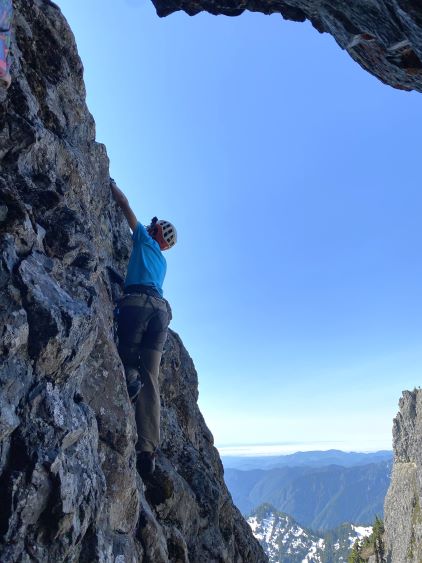

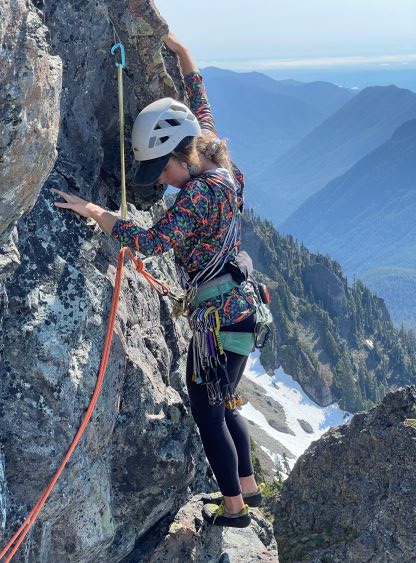
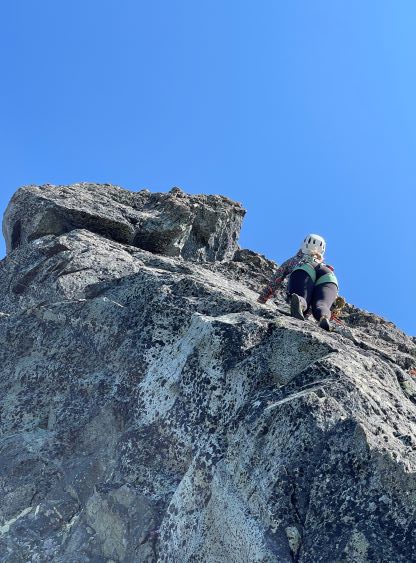
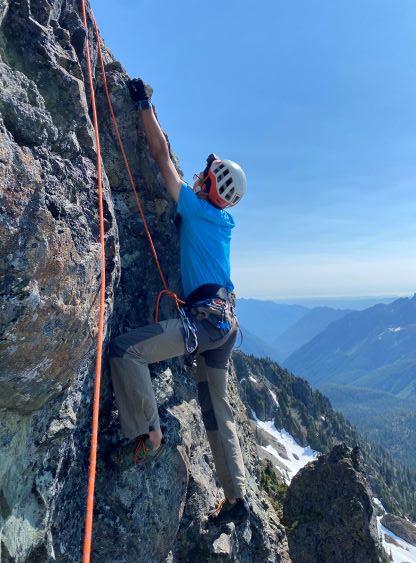


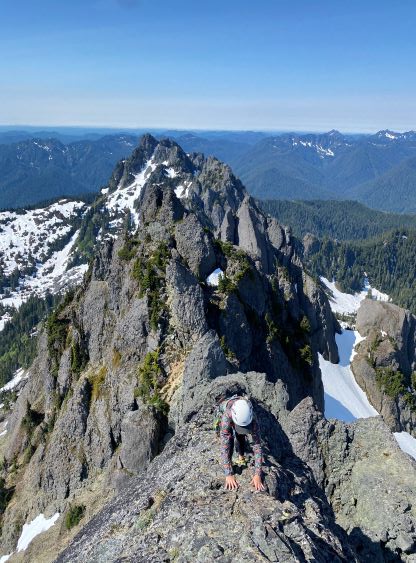

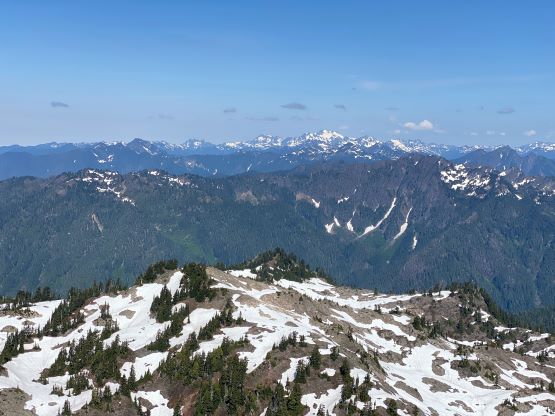
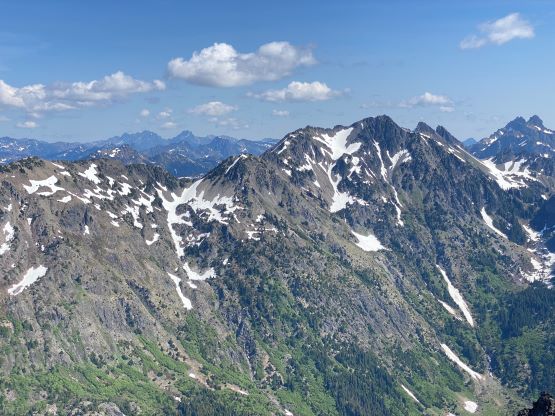


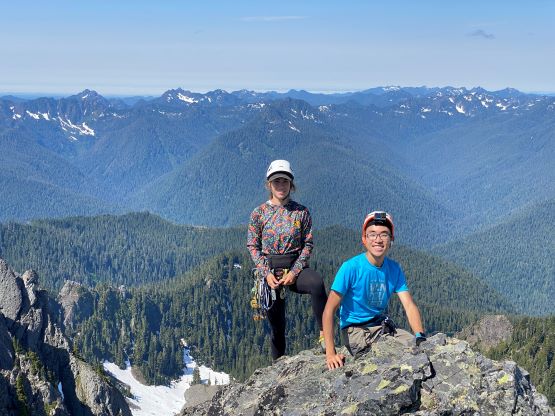


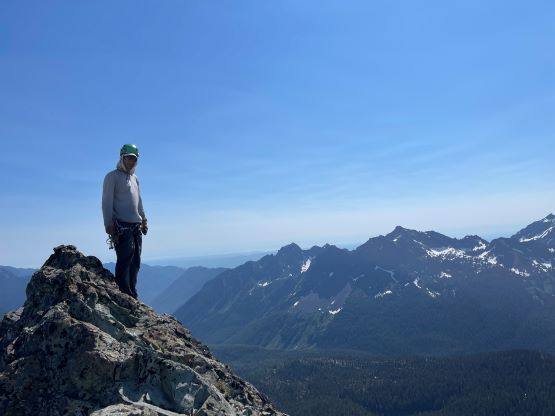
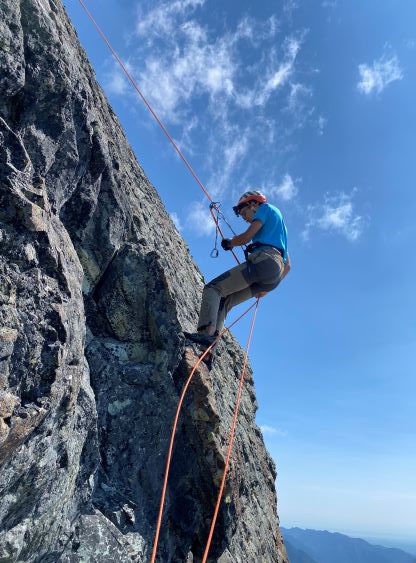
After down-scrambling back across the knife edge it’s time to rappel. Getting into the rappel was tricky. I ended up just soloing a few more steps down the exposed ridge and traversed into a position where I could easily set up the rappel. The rope seemed to get tangled so I went down first to clean that up, while Elise stayed behind to coach Kostya since this would be his first ever rappel. Kostya then came down, slowly but steadily. There’s a short transition to the next rappel where we descended that lower 5th class pitch into the cannon hole gully. This time Elise went down first and I stayed behind to coach. I don’t know if Elise missed out the next anchor but the bottom of this rappel was just in the middle of the gully. We were still above the harder moves and there’s no anchor around. Elise and Kostya were already down-climbing so I had to do the same. This was contrary to what I read as most people did 3 rappels to completely get to the bottom of this gully. Nonetheless I coiled the 60m rope and down-climbed. On 4th class terrain I usually felt the down-climbing to be easier and there’s no exception this time. After changing footwear back to mountaineering boots the others had already found a way to skirt around the snow slope. Kostya was struggling to make some moves and that did not boast my confidence, so I down-climbed the snow, again by using my fingers and I got down faster than Kostya. They later said that traverse above the snow was the hardest in this entire day, so I’m glad I didn’t follow.
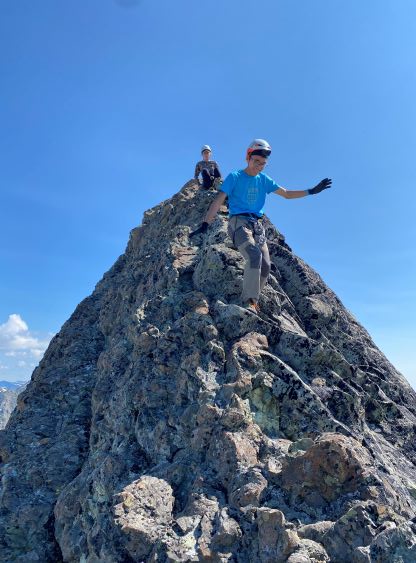



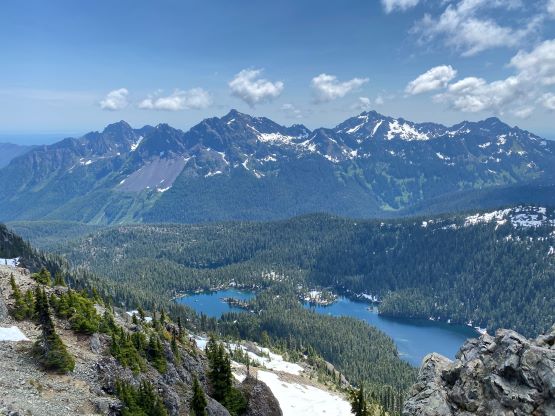
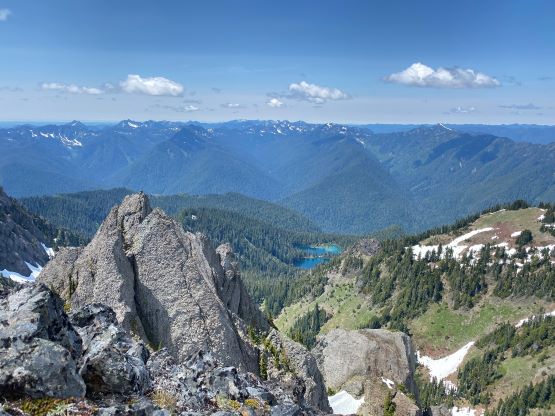
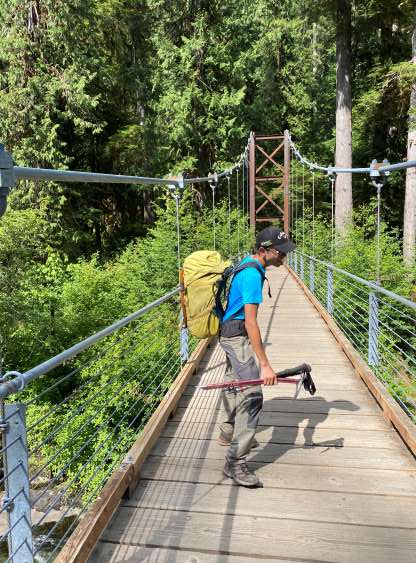
A short break later we re-ascended the two tedious gullies back to the top of “Beta”, now in the smoking heat of the day. Thankfully the mosquitoes hadn’t come out yet for the season. The scramble down from “Beta” required some caution but the descent from Needle Pass was straightforward. We all strapped the crampons on and down-climbed the snow. I mostly descended facing outwards except for one short stretch in the middle. Kostya then made the decision to add Mt. Gladys. I normally would do the same, but I was already exhausted. Kostya is the fastest descender among the three of us, so Elise and I might as well get a head start. I carried that 60 m rope both ways so from Flapjack Lake downwards I gave up on the speed. I then descended a “Vlad’s pace” down to the flat main trail. Elise was already far ahead nowhere to be seen, and Kostya caught up from behind after running the entire way. I wanted to see how fast he could run with a heavy pack, so I made Kostya to switch backpack with me. The 22-liter pack he gave me felt like nothing, so I started to run again. We ran all of the downhills and caught up to Elise at the bridge crossing North Fork Skokomish River, and eventually finished the trip in just over 13 hours round trip. My GPS said over 5 hours of the 13 hours were stopping time. I don’t know how Kostya was still awake to drive but with the help of the auto pilot mode in the Tesla we eventually got back to White Rock at 10:30 pm, exhausted but satisfied.







 Steven's Peak-bagging Journey