Big Kangaroo
July 2, 2023
2538m
North Cascades Highway, WA
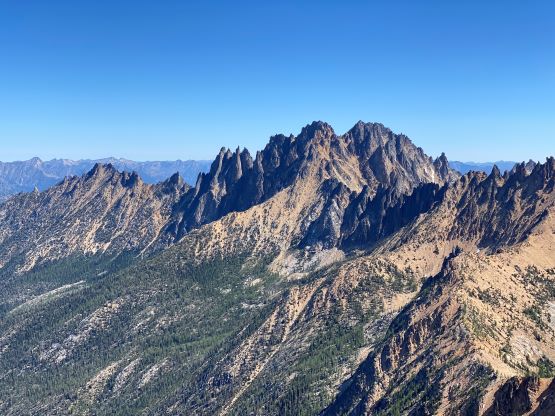
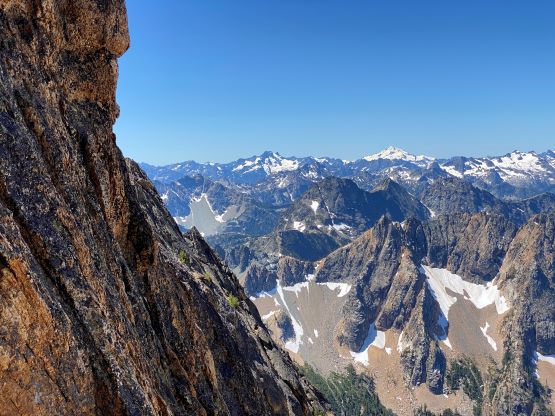
“Big Kangaroo” is the highest granite tower on the rugged Kangaroo Ridge and is one of the more obscured climbs in the immediate vicinity of Washington Pass. The standard route requires a few short pitches of rock climbing up to 5.6 and the approach requires some bushwhacking and choss bashing. The precise elevation of “Big Kangaroo” had recently been surveyed by Eric Gilbertson using Theodolite from three vantage points with previously known elevation, that it becomes one of the newly-discovered Washington’s highest 100 peaks. This resulted in Luna Peak being kicked out. It might seem like I did this peak solely because of the surveying result but that’s not the case. Elise and I had been talking about Big Kangaroo for at least a year and we just happened to have pulled the trigger right after Gilbertson’s survey. We wanted to have a short day but we also wanted the objective to require some degree of rock climbing, so off we went towards Washington Pass for another time.
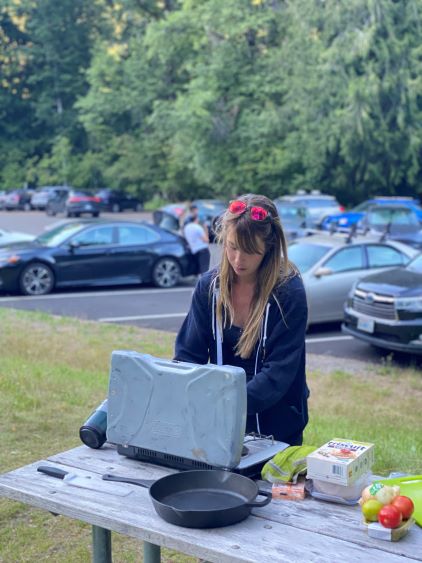
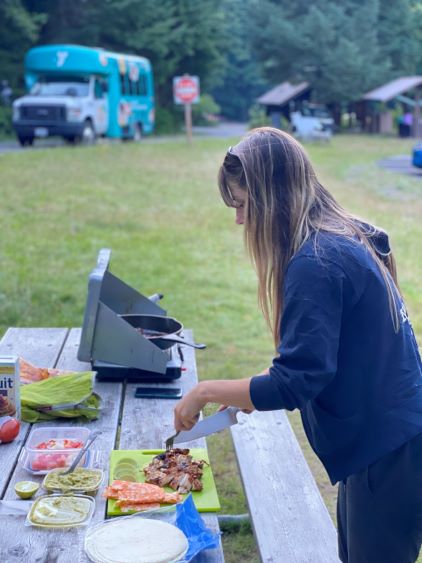
For some odd chances we did not have to rush this time. Instead of leaving home at an ungodly hour or arriving at the trail-head at midnight we were able to leave White Rock at 4:30 pm for a leisure car-camping routine. Elise had brought a proper front-country camping stove with raw chicken and the plan was to find a random parking lot with views and cook tacos for dinner. The original plan was Thunder Bay on the shore of Diablo Lake but we forgot this was a long weekend Saturday. The parking lot was a zoo, so we went for the campground right next to the lake. We were able to find one empty table to lay out the cooking stuffs. There would have no view, but this place was as good as we could find. The cooking was fun and the meal was excellent. We even earned ourselves extra time for some tourism things at Washington Pass’s overlook. The trail-head was at the hairpin but wasn’t ideal for camping. Instead, we drove further and parked right before Burgundy Col’s parking lot, and set up the tent. It was a bit too early to sleep but we went into the tent nonetheless. The alarms were set at 6:30 am but realistically we were planning to just wake up naturally.

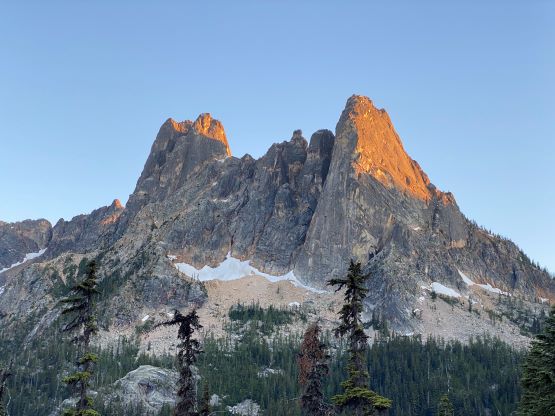


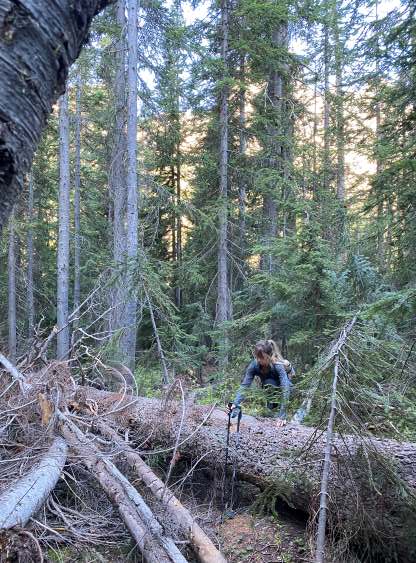
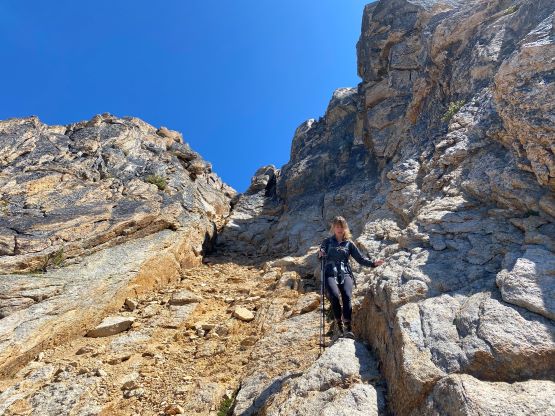
The reason to start later was to dodge the brief but intense wind storm. The forecasts showed the winds dying down by mid-morning so there’s no point in starting too early. The initial approach follows the same trail as one uses for Kangaroo Temple and Wallaby Peak but only for a short distance. As soon as the trail crosses a boulder field we left the trail to cross Early Winters Creek. There were still abundance snow at this elevation and we easily found a snow bridge to cross the creek. Once on the other side of the creek we started the bushwhacking. The thrashing was not terrible, but thicker and slower than expected. I had previously downloaded the GPX track provided in Eric G. and Nick R.’s trip as well as their route descriptions. It seemed like there were many ways to ascend to the base of the climb but I opted to just blindly follow their track, as it had already been proven. The bushwhacking eventually yielded to choss-bashing as we entered an obvious gully. It was difficult to find stable rocks to scramble on. At the top of this gully we scrambled left to cross a ridge feature, and then entered the next (steeper and looser) gully which eventually would lead us to the base of the summit climb. We took our first energy break of the day on this ridge.
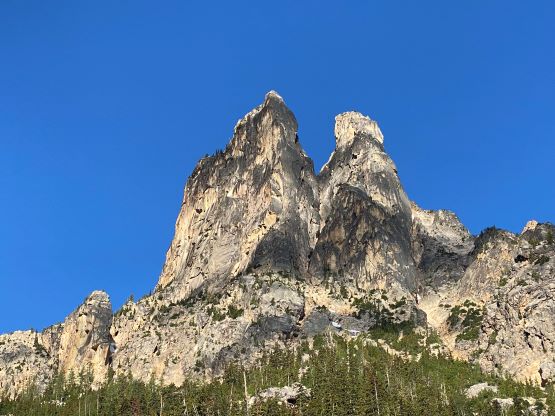
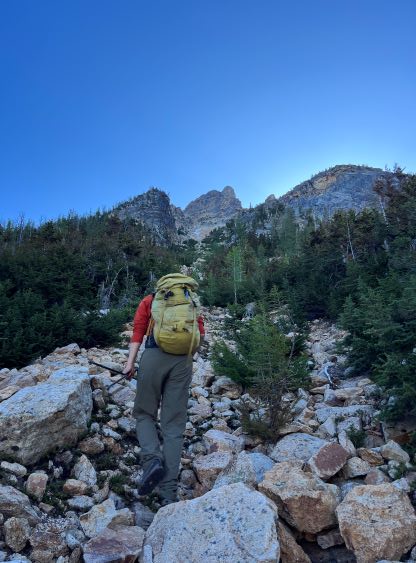
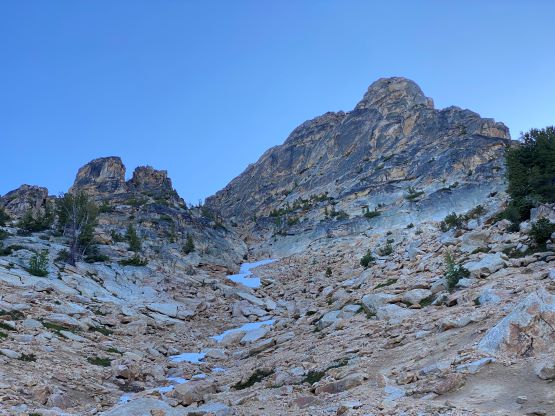
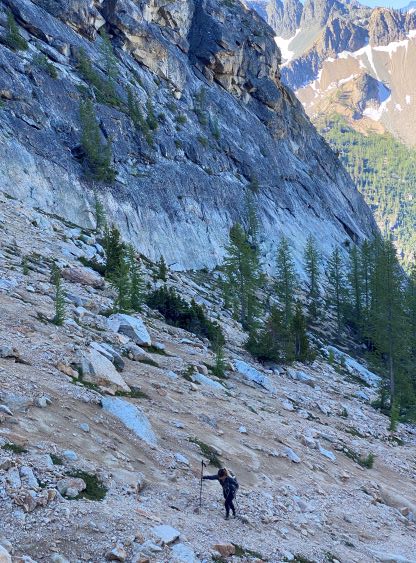


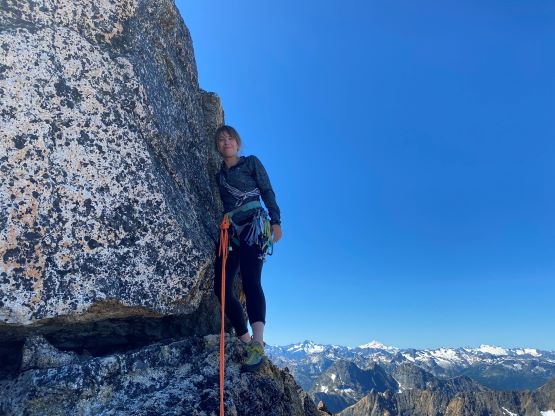
To plod up the upper gully we stayed mostly on climber’s right where we could find solid rocks here and there. I had decided to wear approach shoes instead of the mountaineering boots and the approach shoes weren’t the greatest on choss, so I needed to be extra careful. The gully eventually gave way to a short chimney scramble (class 3+) and then we were at the base of the first pitch under the cannon hole. The first pitch appeared like a scramble so we just soloed it after donning rock shoes and ditching the backpacks. I did not know how to make a rope backpack so it was a bit of an awkward move to bring the 60-m rope up while free soloing. I would rate the pitch to be as hard as “low 5th” for a few moves. The majority of this pitch definitely does not exceed 4th class.


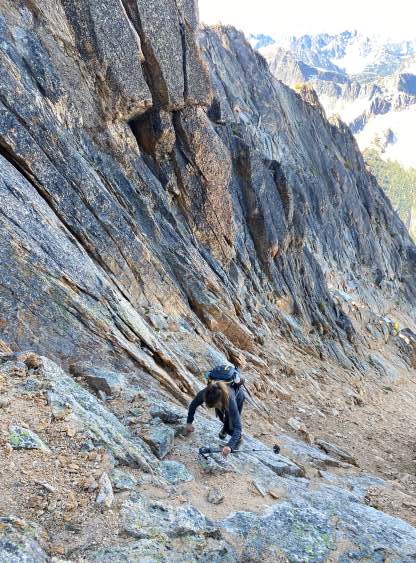

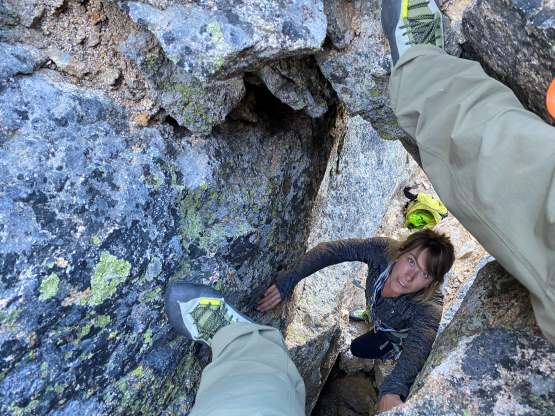

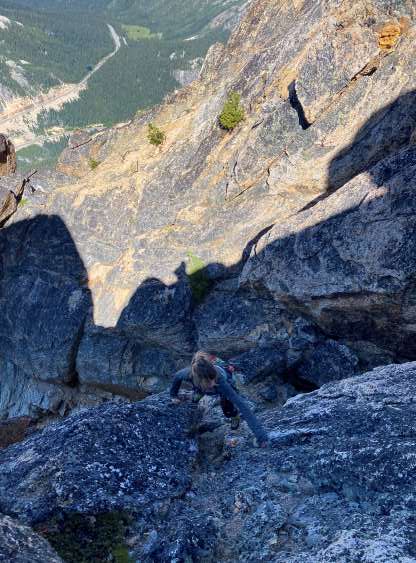

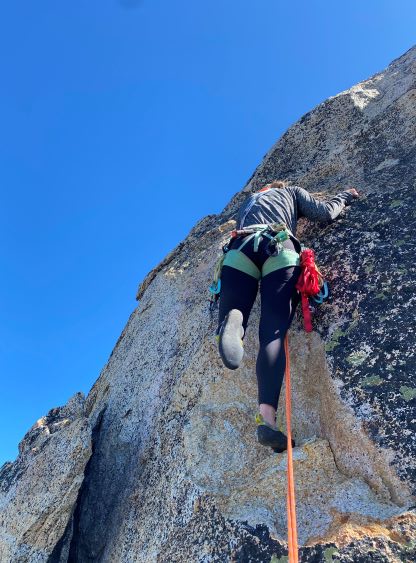
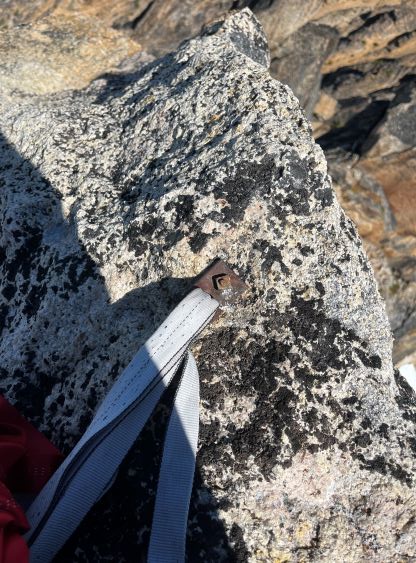
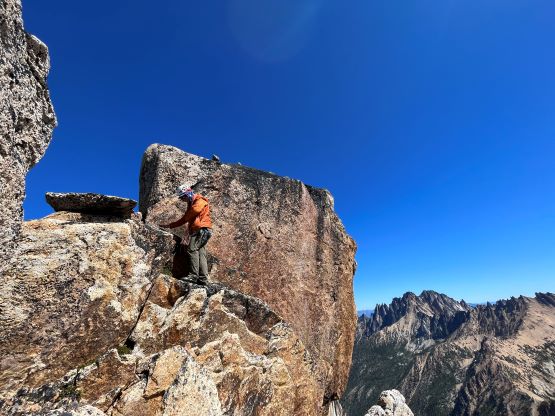
The top of this pitch was right at a rappel station. Beyond that we had a short 4th class down-climb onto a wide ledge on the sunny (east) side of the summit. The true summit was the obvious tower to the south, and next pitch traverses across a thin and exposed ledge on the right (west) side of the summit tower. I carried the rope to the base of the tower to inspect the ledge and immediately decided to just scramble across. Though deadly exposed, the moves were rather straightforward. It turned out to be harder than I thought as the worst part was on the far end, with chossy and down-sloping food “holds”. I told Elise to just scramble across but I had already decided at this point to belay each other across on the way back. There’s one boulder that we used as a belay station, and Elise volunteered to lead the final 5.6 sparsely-protected summit slabs. Just like the previous groups Elise was able to put one 0.3 cam at halfway point and that’s it. The rusty mangy bolt was still on the summit, and so was the fixed sling set-up, but we couldn’t trust them. Elise climbed the upper portion from far climber’s left side and then down-climbed on far climber’s right side with me giving a top rope belay. On my turn I just climbed the middle of the face where the fixed sling was dangling, and down-climbed the same route that I took. I would rate this climb to be proper 5.6 and the down-climbing was quite a difficult fair. It took me a while to figure out a sequence.








After belaying each other back across that exposed ledge we spontaneously decided to take a long break on the sunny side of the wide ledge, but the problem was that we had previously ditched the backpacks at the base. The solution was for me to rappel down, grab the food/water in one backpack and then free solo back up this first pitch. It was a bit of an interesting move to squeeze through that cannon hole with the 50-L backpack, but I made it work. The second time scrambling this pitch felt even easier than the first time. We then took a long break (at least half an hour long). Eventually it’s time to go home, so we both rappelled, but then the rope got stuck. Due to rockfall hazards I didn’t even bother to try freeing the rope from below. Instead, I soloed up this pitch (halfway up) for the third time and freed the rope from above, and then down-climbed. Now that’s the end of the fun parts. To descend this mountain required a lot of patience with choss and bushwhacking. I did not enjoy this descent as I was already tired from the non-stop peak-bagging in the recent weeks, but we did suffer it through. I also made a route-finding mistake near the bottom by missing out the creek crossing. We ended up not able to find the trail and we just thrashed the entire ways back to the parking lot. Our round trip time was 6 hours on a very leisure pace.




 Steven's Peak-bagging Journey