Nursery Peak
February 19, 2024
2098m
Chehalis Area / Harrison West, BC
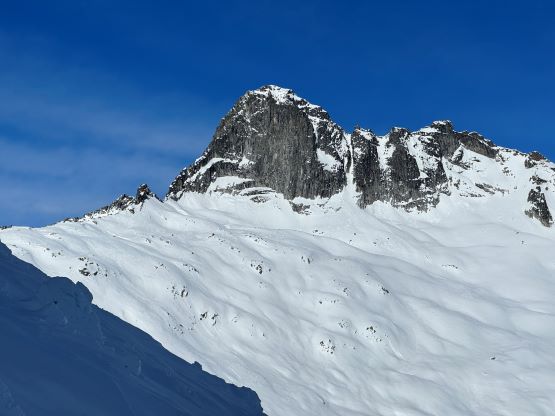
The obscured Nursery Peak in the Chehalis group is rarely climbed. There were only two reliable trip reports out there. Doug Kasian did the first ascent in spring 1978 whereas a ClubTread trip report documents a summer ascent in 2011 with some details. The summit is a rock tower and the only route is via the obvious gully/ramp on the east face. Judging by the two existing trip reports it can be concluded that with sufficient snow coverage this is a 50+ degree snow climb, whereas without snow coverage this is a 4th to low 5th class rock climb. The access is by the logging roads in Eagle Creek drainage, which are accessed by the Mystery connector from Harrison West. This lengthy access requires over 50 km on logging roads and could not be done until “late spring” in a normal year but the winter of 2024 had been exceptionally warm such that there had been hardly any snow below 800 m elevation in all of SW BC. Chris G. suggested Nursery Peak a couple days ago. I liked the idea of making a winter ascent and I did think that the higher snowline could grant the access. I went to the Sentinel Hub Playground to check the up-to-date satellite images and confirmed that the roads were snow free all the way to within 3-4 km from the end. Still, I could not bluntly put my fate on these FSRs with unknown status so I suggested Chris to make a reconnaissance trip. Chris had the entire long weekend free of obligation whereas I had to work on Saturday and Sunday. The scouting trip was then made on Saturday and the result was promising. There was some dead-falls blocking the road but Chris drove to ~6 km from the road’s end.
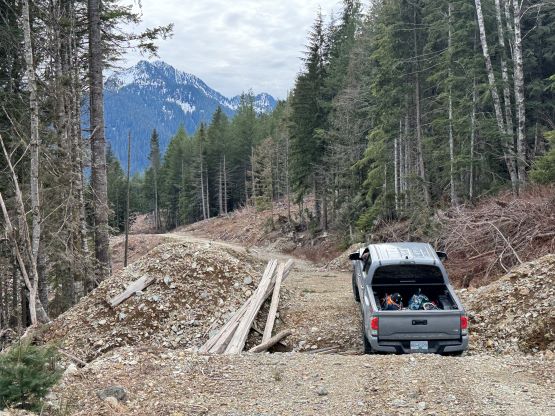
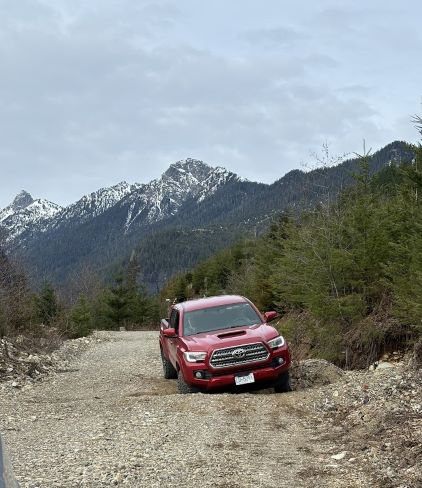
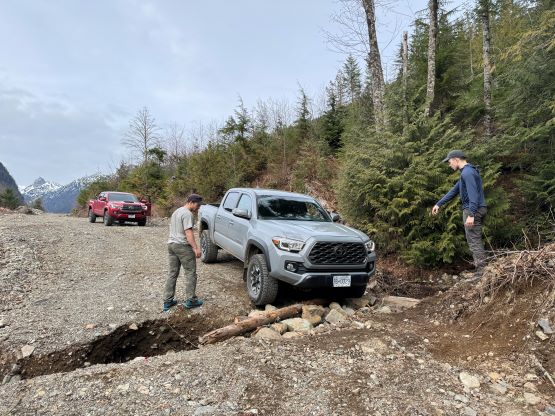
I had a chainsaw so I was positive that we could drive at least a little bit further, and the plan was then made to make the attempt on Monday. There had been some serious and unpredictable wind slabs problems but the avalanche rating had dropped back to M/L/L such that we felt confident to pull the trigger. Noah agreed to come along and Francis and Alex B. also joined the team at the last minute. The five of us would be transported in two trucks and the plan was to car-camp in order to start bright and early on the summit day. Francis, Alex and Chris left home a few hours earlier whereas Noah and I did not leave until 9:45 pm on Sunday thank to my abnormal work schedule. About an hour later I received a text message from Alex’s inReach that they had cut the logs and driven 3 km further than Chris’ scouting trip, but not without difficulties. A couple hours later Noah and I also arrived at the deactivated portion of this access after turning north from the Statlu Lake trail’s junction. The other group had spent an hour to fill in the deepest wash-out by rocks and logs but there were a couple more troublesome ditches and they all scraped the bottom of my truck. Noah and I thought the others were nuts. I kept pushing because I knew it’s “doable” to at least where the inReach message was sent from, but for them the road conditions would be entirely unknown. We encountered about half a dozen massive ditches after crossing Eagle Creek to the west side, but had no problem making to where Francis’ truck was parked. It was 1:30 am when we arrived and my plan was to wake up at 5:30 am in order to be at the bushwhack at the first light. I simply slept on the passenger seat whereas Noah opted for an open bivy on the truck’s bed.


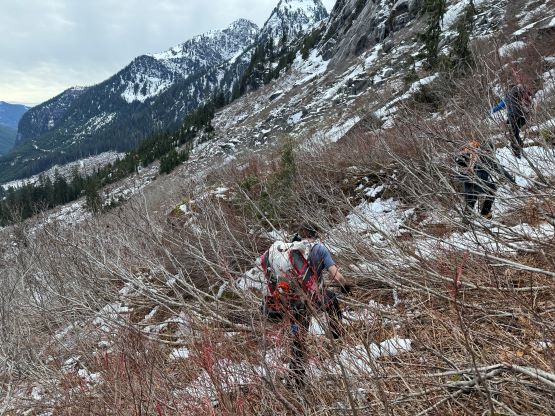
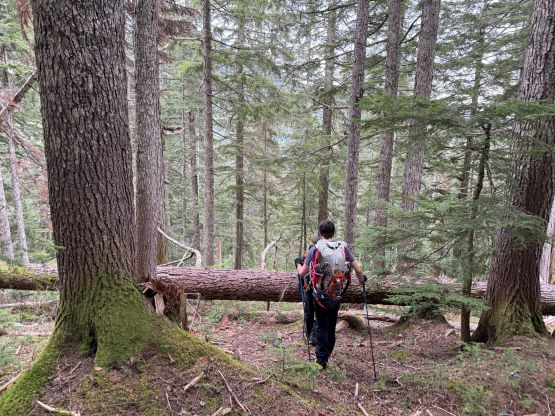
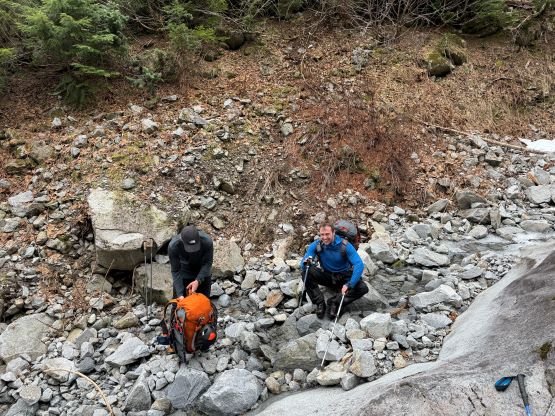
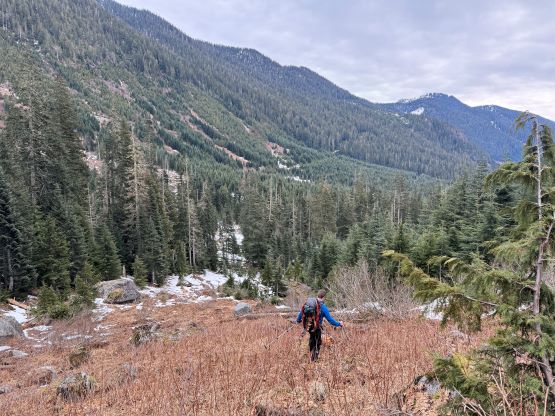
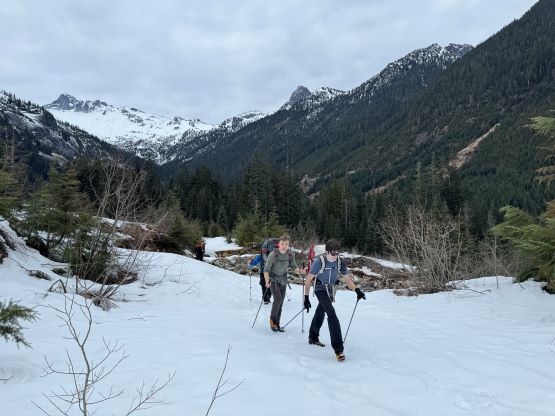
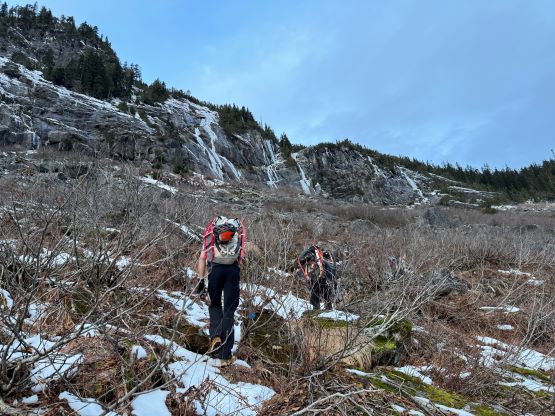
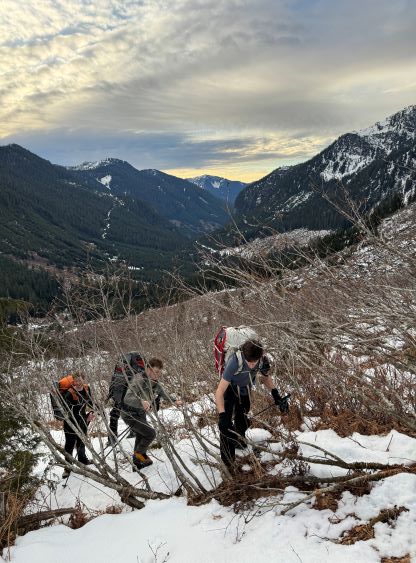
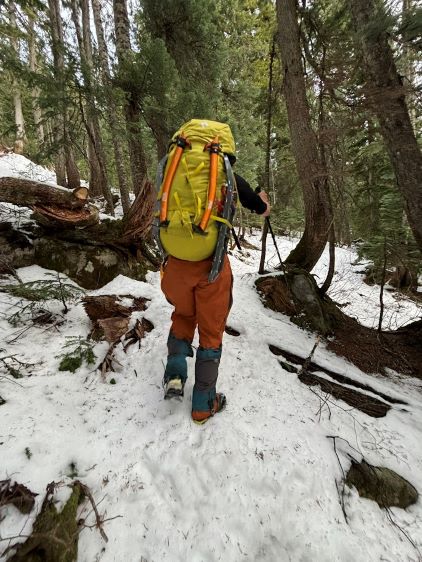
Noah and I did not plan the starting time with Francis, Chris and Alex but I was already awake at 5 am. I did not see a single head-lamp through the window and I was exhausted from work and the long drive so I immediately went back to sleep. By 5:30 am I was still not able to see anyone getting up, so I got out of the truck and woke everyone up. I planned to be at the absolute road’s end at the “first light” and it’s time to get the ball rolling. It’s worth noting that I was the only one bringing a bike but because we had driven so far in (within 3 km from the road’s end) the bike was no longer needed. I still preferred to put it in use but it was difficult to keep up with the rest of the crew had I kept pushing the bike on snow. I eventually parked the bike after about 1.5 km and proceeded on foot. The snow on the road had soon become continuous and the condition was firm and crusty. In no time we made to the creek that drained from Nursery Pass. The bridge was long gone but the rock-hopping was easy. The final kilometer was overgrown but with 1-2 foot of condensed snow we did not have to do any bushwhacking. Unfortunately there was hardly any snow coverage on the slide paths, boulder fields or in the forest, that we were still due for a thrash to access the 1100 m cirque under the south slopes of Grainger Peak. Alex and Chris took turn leading us traversing diagonally across several large slide paths. We all had done some extensive research about this section as it’s also the standard approach to Grainger Peak’s south face. There was no GPX to be found, but the route was more obvious than we thought. The bushwhacking was “tame” by the coastal standard and the boulder fields were also not that slick. The mature forest was mostly open and free of underbrush, such that we made to the 1100-m cirque in just over 2 hours after leaving the truck. Our progress was much quicker than I thought. We all donned snowshoes before the short traverse/descent into the cirque.



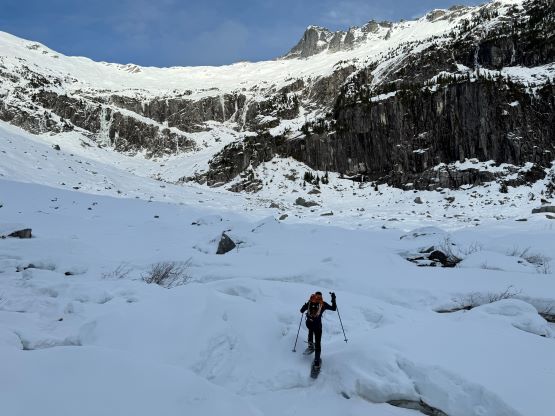
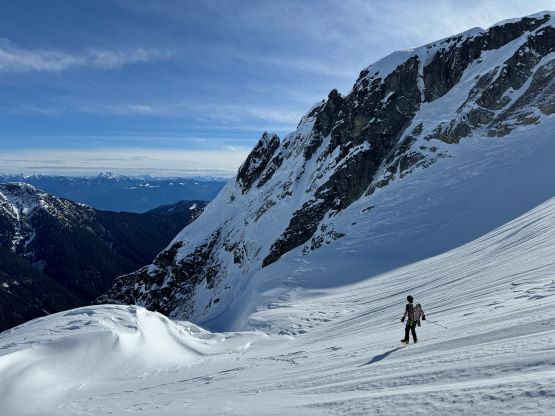
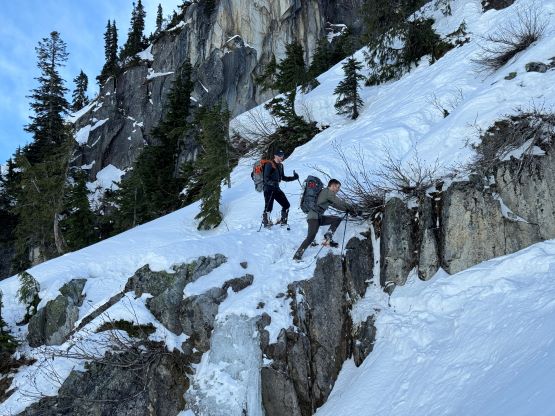
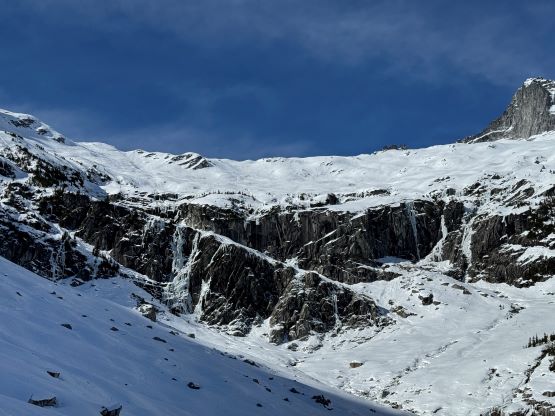
There are a few ways to break through the headwall surrounding this cirque and most parties (not that there’s a lot) that ascended the numerous summer routes on the south face of Grainger Peak took the diagonal ramp option. That ramp could work in winter, but even a small slide could be disastrous so I had studied a few other routes on the far climber’s left side by digging out some internet photos, including but not limited to a hidden chute/gully. After seeing the conditions in person we decided to take the alluvial fan option which would grant the most direct attack. The slope above the fan appeared to be steep with a few potential cruxes but I was sure that we could figure out a solution in situ. The snow condition was mostly as expected. For the next 1000 m elevation gain we would be mostly travelling on stiff wind slabs that were able to support our weight, breakable wind slabs, deep powder and surfaces that had been scoured down to the old crust and the four types shared roughly equal proportions. The trail-breaking was heinous on sections with breakable crust and deep powder. The wind slabs had been constantly discussed but we observed no sign of instability nor heard any “whump” so we kept going, even though a slide could be quite consequential on some places. There was also one rock step that involved some shenanigans, that I called the ultimate test of one’s “technical snowshoeing” skills. We all passed the test and ascended into what I would call the “middle draw”.


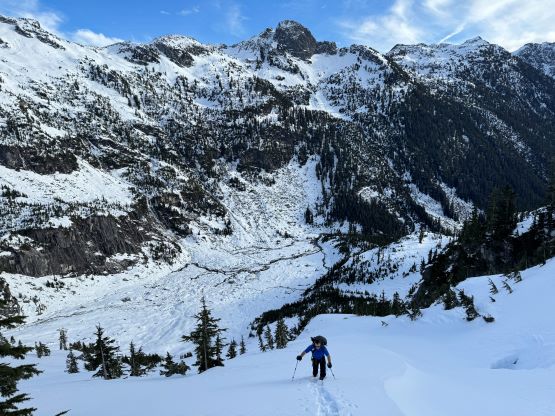
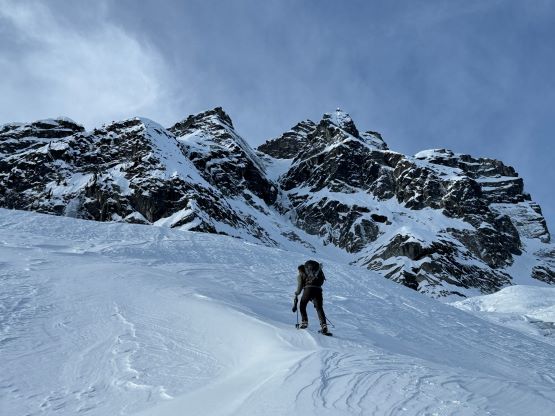

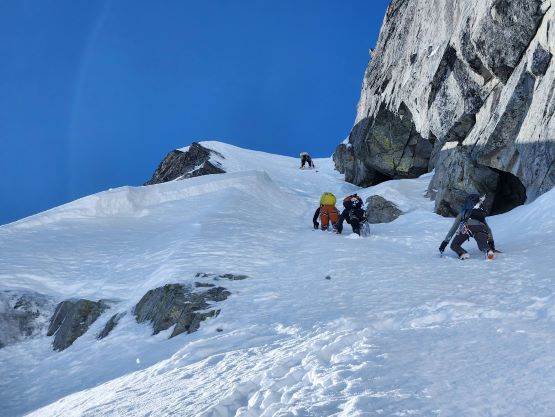
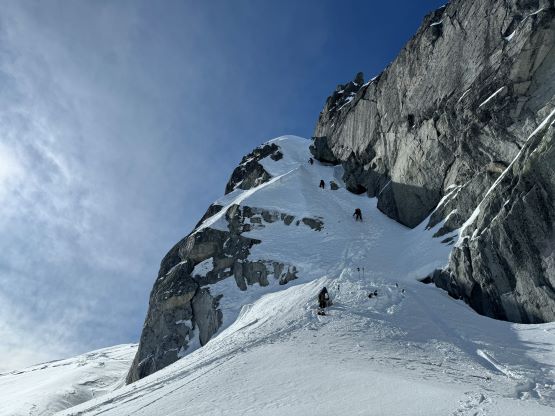
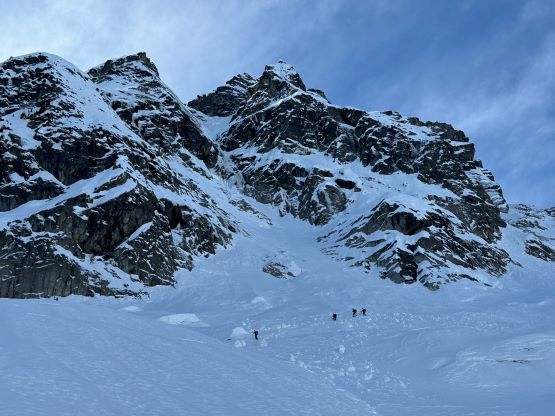
I had outlined two possible ways to surmount this “middle draw” but the direct attack of the east slopes underneath the upper glacier seemed “reasonable” and felt actually much safer than what we had just done lower down, so we would take the short way. There was some avalanche debris, a lot of breakable crusts and some sections of deep powder that made for some tiring wallowing. Our progress was slow but steady and again, all five of us contributed roughly equally to the trail-breaking job. There were two steeper constraints. Alex and Francis led a bypass of the first constraint on climber’s right side on some 35+ degrees wind slabs, whereas I directed us straight through the second constraint in the middle of the gully, and the next thing we exited this “middle draw” and arrived at the bottom of the upper glacier. There were some sagging so we donned our harnesses. We did not bother to take the rope out as roping up in South Coast in February was seemingly an overkill in my opinion. The east face gully/ramp was initially looking discontinuous with at least one pitch of mixed climbing, and that made Noah excited and plodded far ahead to scout things out. It was unfortunately (or fortunately) connected as the ramp itself was hidden from view until we were directly at the base, so it would go as a non-technical snow climb after all.

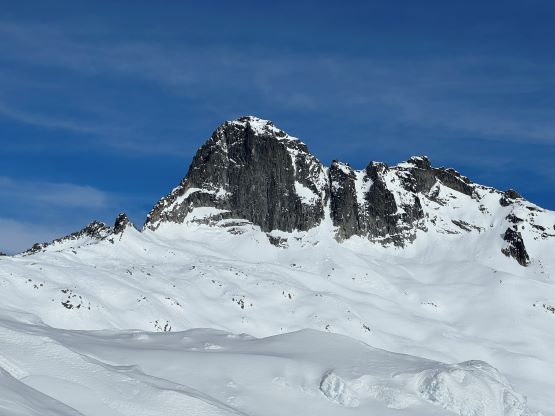
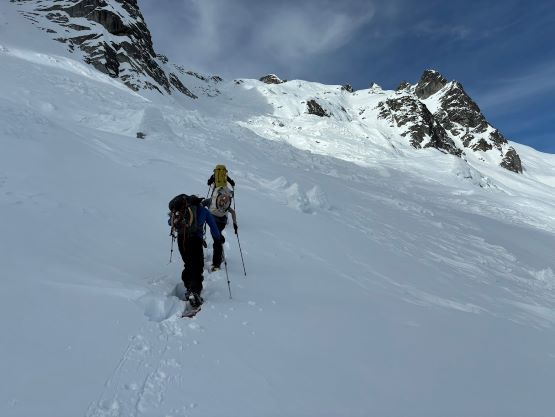

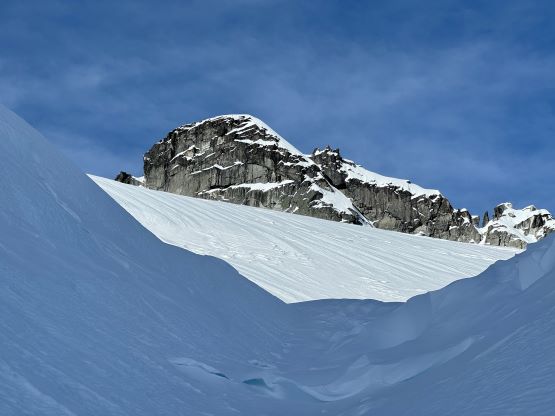


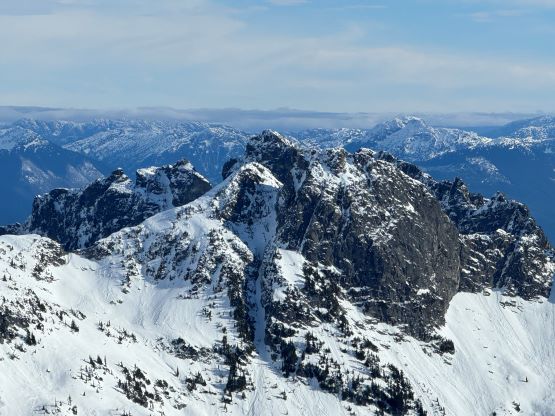
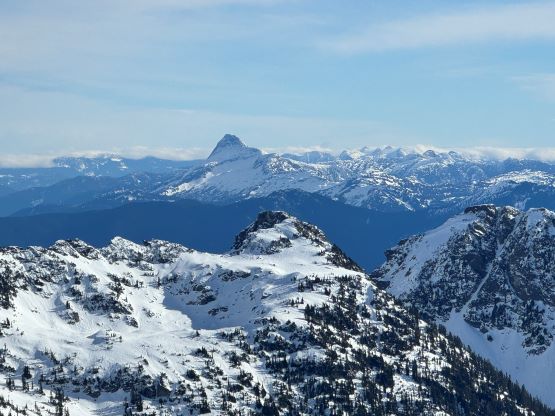
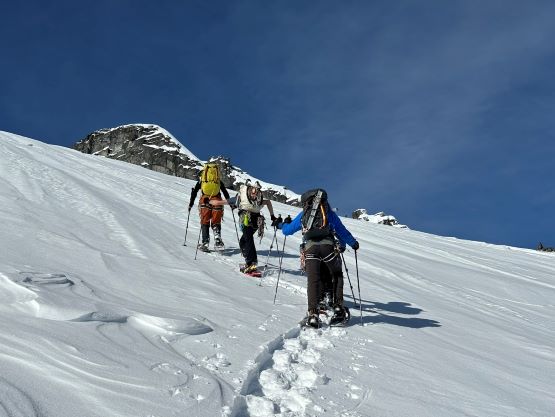
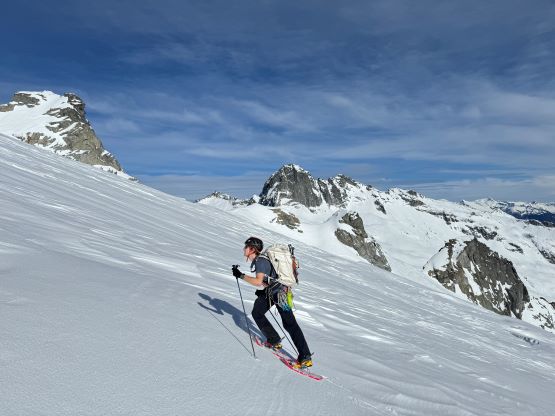
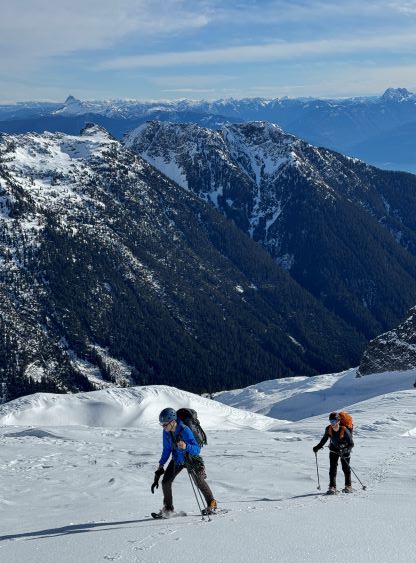


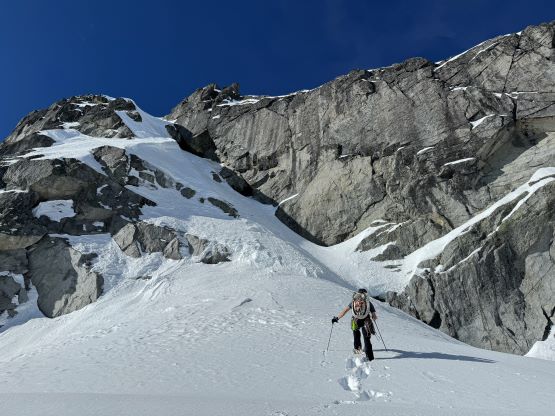
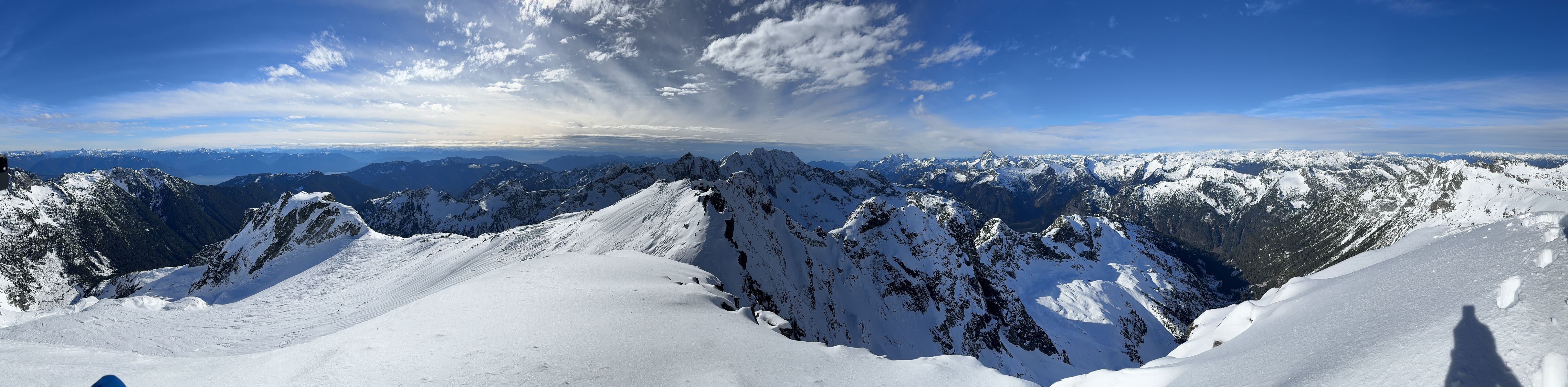
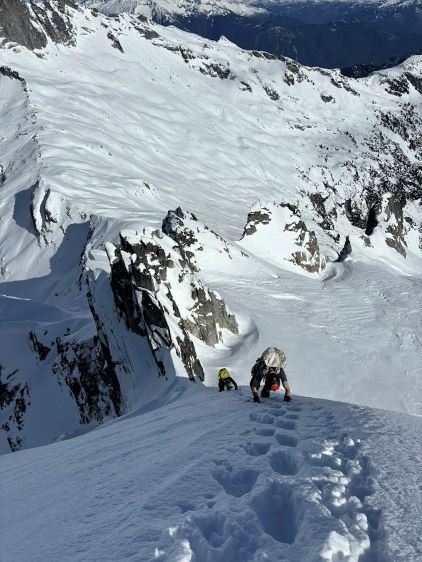
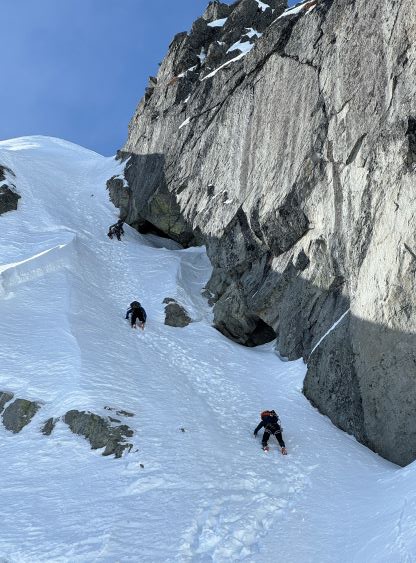
I think a few of us were keen on leading, but whoever got to climb first depended on each of our transitioning speed. I thought I was done and about to go up but then Noah was already starting, beating me by about 20 seconds. There was some deep wallowing at the start and Noah’s lightness helped him staying on the surface. I sank in chest deep following his tracks and had to use some trenching techniques to get up that initial steep step, which could possibly be a moat. I lost some time here so Noah was already halfway up the couloir by the time I finally got onto the firm snow. The climbing condition was perfect. The 50+ degrees middle/upper couloir did feel rather exposed but the ice tools and crampons were biting excellently. I took a short break after finishing the couloir section before committing to the exposed snow arete that would grant the access to the summit, as my calves were burning and needed some rests. This snow arete felt very much like the last pitch on Mt. Judge Howay. The climbing was easy but the exposure was real and the snow quality had deteriorated a little bit near the top. Nevertheless we all made it and agreed to down-climb on the descent, so I did end up hauling the 60-m rope up and down this mountain for weight training. It ended up staying on the bottom of my backpack without being taken out from home to home.
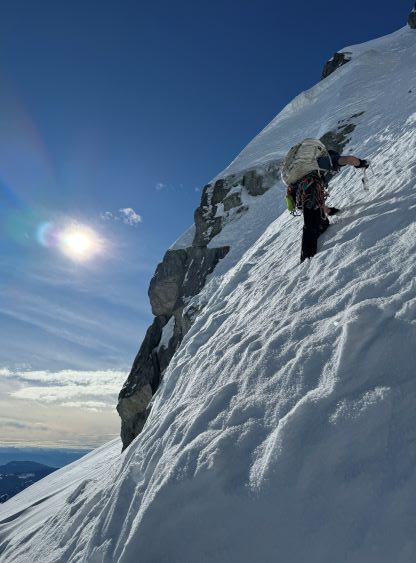


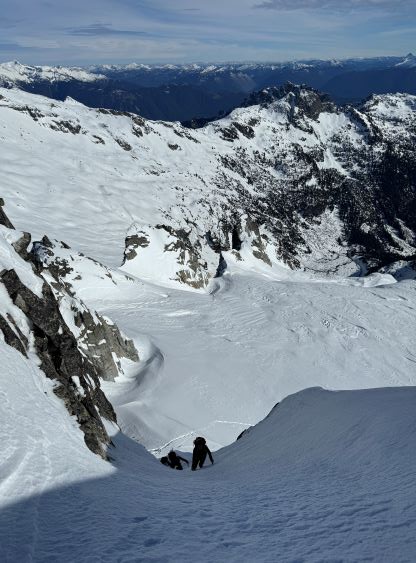
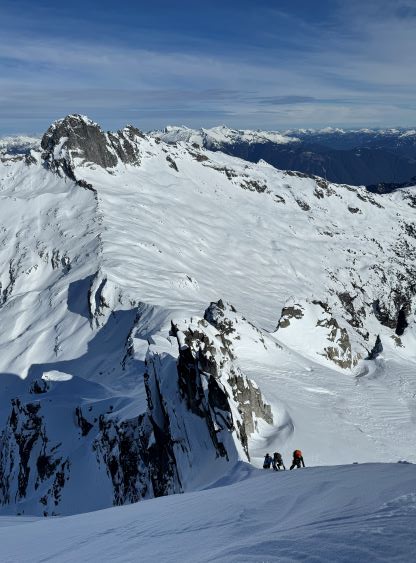
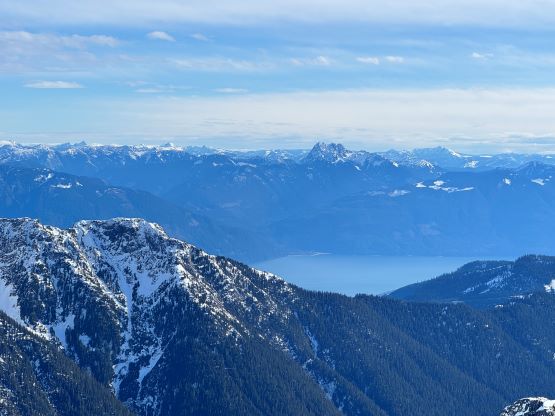

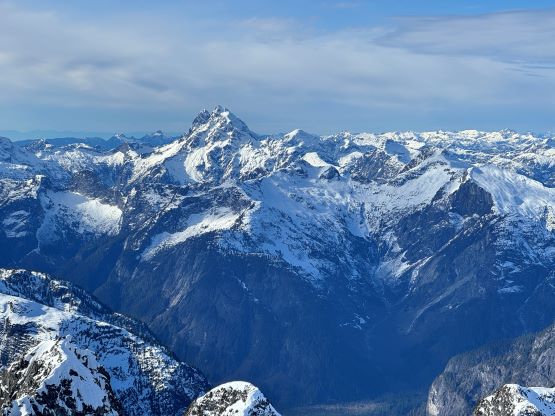


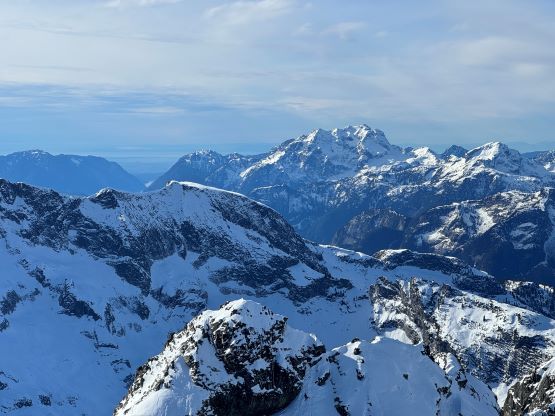
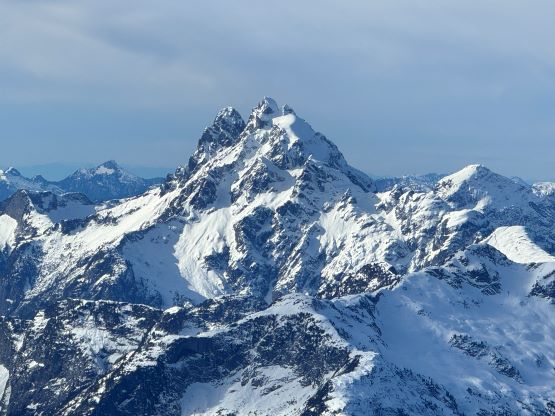


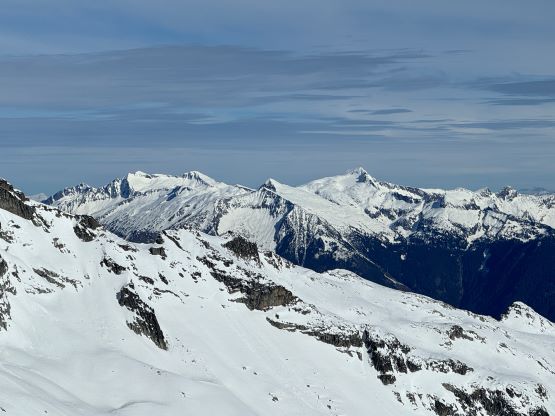

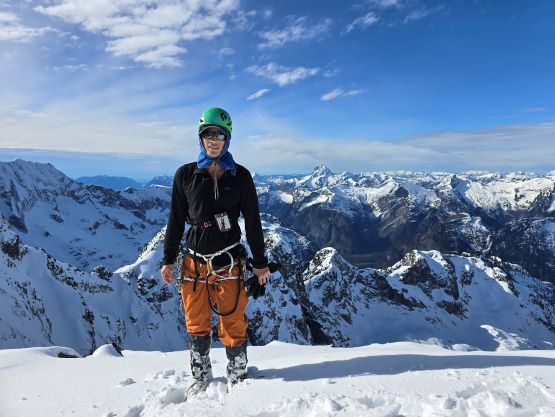

The down-climb was actually easier than I thought, as the five of us together had reinforced the bucket steps so all I needed was to find the next steps and put my feet in. I then did a quick transition from crampons back to snowshoes and plodded down to the next “rest stop”, which was underneath this east facing glacier. Everyone else opted to bootpack down the glacier and some opted to keep their crampons on. They then decided to continuously bookpacking down the entire mountain whereas I opted to wear snowshoes for the entire way down. There were pros and cons in either way and the solution largely depended on one’s comfort/confidence with snowshoes. I had done over 350 peaks on snowshoes so I knew how to negotiate these types of treacherous terrain efficiently, but then I also paid my price by getting blisters on the toes. The steep grade combined with the variable crusty surfaces had generally some significant amount of torque and I was also pushing the speed for a little bit. The suffering for the other guys on the other hand, was the heinous post-holing and face-planting caused by the breakable crusts. We nevertheless made a single dash down to the exit of this lower cirque. Chris and Noah had ditched their hiking shoes there in the morning but they decided to wear the boots out to save from doing another transition.



I opted to keep wearing the snowshoes as I remembered a few questionable spots around some boulders and I did not want to discover some big holes there. This turned out to be unnecessary as the foot steps were rather secure, so I was the one that needed to make an annoying transitions (snowshoes off), and the result was some running in the bushes to catch up. Chris and Alex then went ahead to lead us back across these slide paths and the pace was rather furious. This was another trip that I had to be 100% in my elements just to keep up with the pace, especially on the descent through the bushes. After getting back to the FSRs we decided to speed things up further more as Noah pointed out that we could possibly finish this supposed 15-h day faster than our Gotha/Coburg trip a couple days ago, so we rushed and jogged the final few kilometers back. I fortunately did not have to jog the last kilometer as I got to my bike, zipped past everyone else and finished a few minutes earlier. Our round trip time was 8.5 hours. I am not someone obsessed about “firsts” but if anyone has done Nursery Peak faster than this time, or has climbed Nursery Peak in winter by any route please let me know because I’m curious if we had actually made both the FWA and FKT on this objective. We were not home free yet, as the crux was actually the 4-wheel-driving. Thankfully the two dozen ditches did not impose much of a problem to both Tacomas on the way out, and we were back to Mission around dinner time.